

https://www.internationaldisabilityalliance.org/blog/youth-leadership-no...
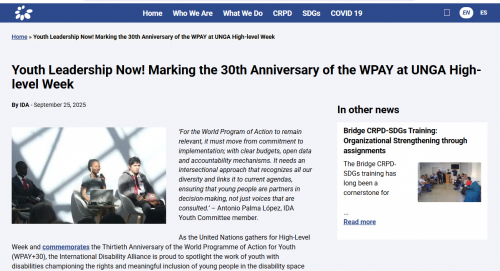
For the World Program of Action to remain relevant, it must move from commitment to implementation; with clear budgets, open data and accountability mechanisms. It needs an intersectional approach that recognizes all our diversity and links it to current agendas, ensuring that young people are partners in decision-making, not just voices that are consulted.’ – Antonio Palma López, IDA Youth Committee member.
As the United Nations gathers for High-Level Week and commemorates the Thirtieth Anniversary of the World Programme of Action for Youth (WPAY+30), the International Disability Alliance is proud to spotlight the work of youth with disabilities championing the rights and meaningful inclusion of young people in the disability space and beyond.
Antonio Palma López, IDA Youth Committee Member, will serve as a panelist at the High-level Meeting to Commemorate the 30th Anniversary of the World Programme of Action for Youth, taking place on Thursday 25 September at UN Headquarters in New York.
Thirty years after the adoption of the WPAY, the message from young persons with disabilities is clear: nothing about us without us – including in policy, financing and accountability.
IDA has long championed the implementation of the CRPD through an intersectional lens, advancing the rights of women, youth, and underrepresented groups with disabilities. Our youth engagement work builds bridges between generations, strengthens global disability rights, and ensures that the future is shaped with and by young people with disabilities.
Recent activities of the IDA Youth Committee
At the Global Disability Summit in Berlin, IDA’s Youth Committee launched the Youth Call to Action in partnership with UNICEF and Sightsavers.
The Youth Call to Action, developed through global consultations with youth with disabilities, outlines ten transformative priorities. These include:
- Enabling the full, meaningful and effective participation of all young persons with disabilities in decision-making processes.
- Strengthening and enforcing disability-inclusive policies and accountability mechanisms.
- Investment in digital accessibility and assistive technology.
- Guaranteed inclusive and affordable education for all young persons with disabilities.
- Addressing barriers to economic empowerment and inclusive employment.
- Strengthening social protection and support services.
- Addressing the intersectionality of disability and other identities and compounding forms of marginalization.
- Ensuring accessible, inclusive and affordable healthcare for young persons with disabilities.
- Promoting accessibility and inclusion in sports, entertainment, recreation and cultural activities for young persons with disabilities.
- Promoting disability inclusive data collection and evidence-based influencing.
With the launch of the Youth Call to Action, the IDA Youth Committee co-convened a side event at the Global Disability Summit in April 2025, entitled ‘Youth Leadership Now’. The event brought together youth leaders and governments to identify concrete mechanisms for participation and follow up.
In June 2025 at the 18th session of the Conference of State Parties to the Convention on the Rights of Persons with Disabilities (COSP 18), the IDA Youth Committee, UNICEF and Sightsavers platformed the Youth Call to Action by organizing a side event focusing on innovative financing for youth development.
In July 2025 at the UN High Level Political Forum (HLPF), IDA Youth Committee member Antonio Palma López called for rights based, youth centered, disability inclusive development, stronger accountability, and implementation of the Amman-Berlin Declaration.
As part of the WPAY+30 process, the IDA Youth Committee co-organized with Sightsavers a youth dialogue on the meaningful participation of young persons with disabilities. This dialogue generated powerful recommendations on meaningful youth inclusion and effective participation.
Ripple effects: Shifting attitudes
‘We are not asking for permission to be included. We are demanding accountability. Youth with disabilities are not the leaders of tomorrow, we are the changemakers of today.’
– Esther Nagetey, IDA Youth Fellow.
IDA’s work with youth has already created ripple effects. At the GDS, youth leaders not only presented demands but also moderated discussions and shared stage as panelists with governments and global leaders. What once seemed exceptional is now becoming expected: youth with disabilities speaking as experts, not merely as beneficiaries. These moments challenge stereotypes. They highlight that, when given a platform, young persons with disabilities drive innovation, shape agendas, and inspire systemic change.
Youth inclusion is not a side issue
The inclusion of youth with disabilities is not a peripheral concern—it is central to social justice, human rights, and sustainable development.
The path forward demands bolder action. IDA calls on all stakeholders to:
- Commit to meaningful youth inclusion by institutionalizing mechanisms for youth with disabilities to co-design policies and monitor implementation (not token surveys or one-off panels).
- Resource and implement the Amman-Berlin Declaration, the Youth Call to Action, GDS commitments, and the Pact for the Future.
- Reflect youth input in policy, adopting the 10-point Call to Action as a reference for national strategies on education, employment, assistive tech, health, and participation.
- Fulfill pledges and match words with measurable action, funding, and accountability.
As we celebrate three decades of the World Programme of Action for Youth, let us move from words to action. The way forward is already in young people’s hands.