

https://www.sportanddev.org/latest/news/martial-arts-leaders-highlight-g...
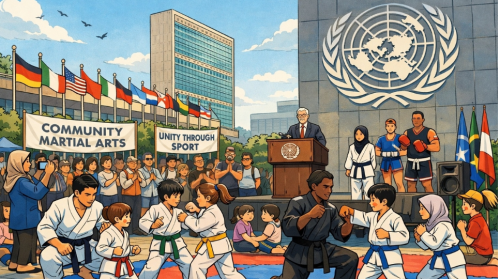
Community-based martial arts initiatives from five continents came together during the United Nations Commission for Social Development for Connected Pathways: Community Martial Arts Models Advancing Social Justice and Youth Wellbeing, a side event highlighting how grassroots sport and martial arts programmes contribute to inclusion, protection, and sustainable development.
Hosted by the Jadir Taekwondo Association (AJTKD) in partnership with the Martial Arts Coalition for Sustainable Development (MCS), the event showcased practical models developed in communities facing inequality, violence, displacement, and limited access to opportunity.
Opening the session, communications specialist Inês Crespo introduced the global scope of the event and emphasized the role of community-driven sport initiatives in advancing social justice and youth wellbeing. Master Jadir Figueira, founder of AJTKD and cofounder of MCS, followed with opening remarks highlighting how community martial arts initiatives contribute directly to the Sustainable Development Goals, particularly in advancing inclusion, youth empowerment, and social protection. He emphasized the importance of ensuring that grassroots voices inform global policy discussions.
The first part of the event featured short video presentations from eight community-based projects across different regions:
- Conscious Combat Club (Australia), by Georgia Verry
- Project Sifu (England), by Wayne Wong
- TRIBE Martial Arts Foundation (South Africa), by Norman Wessels
- The Edinburgh Combat Project (Scotland), by Pawel Zakrzewski
- Nagai Association (Brazil), by Silvana Nagai
- Arte da Luta (Brazil), by Matheus Paoliello
- UTOPIA AC (Mexico), by Jose de Jesus Villalobos
- Kaizen Martial Arts Club Kenya (Kenya), by Lona Abiero
Together, these initiatives illustrated diverse approaches, including the integration of psychosocial support, gender equity, trauma-informed practice, and rights-based education within martial arts programmes operating in challenging social contexts.
The event continued with a panel discussion bringing together practitioners and global leaders working at the intersection of sport, martial arts, and social development. Panelists included Luke Lamprecht (Fight With Insight, South Africa), Špela Lampe Cakići (Judo Golovec, Slovenia), Estelle Jean (Yoga and Sport with Refugees, France), Wayne Wong (Project Sifu, England), and Danilo Malafaia (Martial Arts Coalition for Sustainable Development, Brazil).
The discussion explored how safe and inclusive training environments are created for people from vulnerable backgrounds, the barriers faced by women, girls, and displaced communities in accessing sport, and the visible changes martial arts programmes can generate in confidence, belonging, and self-expression. Panelists also reflected on why networks, storytelling, and coalitions matter for scaling impact and avoiding isolation among grassroots initiatives.
Closing the session, participants were invited to stay engaged through the Martial Arts Coalition for Sustainable Development and to continue building partnerships across regions.
Connected Pathways demonstrated that community martial arts initiatives are already contributing to global development priorities — and that stronger links between grassroots action and international platforms can help scale their impact.
- UN Side Event: Connected Pathways
- Martial Arts Coalition for Sustainable Development
- UN Commission for Social Development
- Youtube playlist with the event's highlights
- Related: Connected pathways: Community Martial Arts models for social justice a…
- Related: Martial arts champions global action at UN High-Level Forum