

https://www.plasticpollutioncoalition.org/blog/2025/12/8/win-on-micropla...
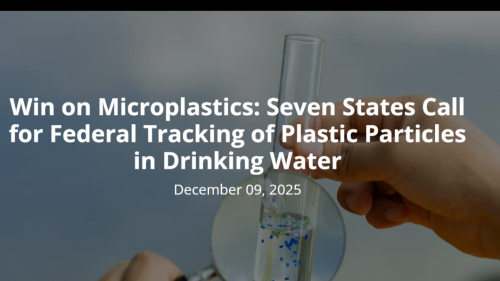
In a bold move to protect human health from microplastics, seven governors are urging the U.S. Environmental Protection Agency (EPA) to launch nationwide monitoring of plastic particles in drinking water, following nearly a year of advocacy from Food & Water Watch and Plastic Pollution Coalition (PPC). If the U.S. EPA honors the petition, the agency would gather essential data across the country to better understand the prevalence of microplastics in drinking water and guide next steps to safeguard human health—representing the first national action on microplastics in drinking water.
Governor Phil Murphy of New Jersey filed the petition on behalf of a coalition of governors from Connecticut, Delaware, Illinois, Maryland, Michigan, and Wisconsin.
We applaud these state governors for championing the call to protect our health from microplastics. With virtually no federal oversight of microplastics, it’s time for national regulatory action that can determine the exposure and risk, inform the public, and ultimately ensure safe drinking water for all.
— Madison Dennis, Project Manager, Plastic Pollution Coalition
This is a momentous step towards gathering critical information we need about the emerging crisis of microplastics in drinking water. We thank Governor Murphy for his leadership on this petition and all the governors that have joined him in this vital effort. We now call on the EPA to grant this petition and get to work. People have a right to know about microplastic contamination in their drinking water.
— Wenonah Hauter, Executive Director of Food & Water Watch
The governors’ petition calls on the EPA to include microplastics in the next Unregulated Contaminant Monitoring Rule (UCMR) in 2027, as the UCMR is issued every five years under the Safe Drinking Water Act. The UCMR is often the first step toward building the case for new regulations and standards to address a drinking water contaminant.
Under the Safe Drinking Water Act, the U.S. EPA is legally obligated to act on this petition unless the Administrator determines that including microplastics would prevent monitoring other contaminants with higher public health concerns. Given the burgeoning research on the widespread health harms of microplastics and their ubiquitous presence in our bodies and environment, there is a compelling case for prioritizing microplastics inclusion in federal monitoring and risk abatement.
Microplastics Risk Our Health

One major pathway of human exposure to microplastics is through the water we drink. Researchers have found that 94% of U.S. tap water samples contained plastic particles. These tiny plastics have now been detected throughout the human body, including in the bloodstream, bones, brain, breastmilk, and reproductive system, and microplastics are linked to serious health issues such as cancer, infertility, and Parkinson’s disease. Microplastics are also made of any mix of 16,000 additive chemicals, with at least 25% categorized as hazardous to human and environmental health.
Given these risks, the U.S. EPA cannot afford to wait to take action on microplastics in our water. A poll by 5 Gyres found that 89% of U.S. adults are concerned about microplastics in the water we drink, the food we eat, and the air we breathe. Instead of leaving states to individually monitor and address the issue, a coordinated national monitoring program would improve our understanding of the crisis and lay the groundwork for future regulations to limit microplastics in drinking water.
It’s important to note that plastic bottled water is not a safer alternative. Studies show bottled water often contains significantly higher levels of microplastics than tap water, while contributing additional pollution from production, transportation, and disposal, with most bottles often ending up in landfills, incinerators, or the environment. Filters certified to remove microplastics can help reduce the amount of microplastics you are exposed to in your tap water. Learn more about PPC’s Filtered Not Bottled campaign here.
Public tap water should be safe and free of plastic particles and toxic chemicals. Collecting data on microplastics is a key first step. With this critical information, the U.S. EPA can further act to prevent harm to our health and environment and pave the way for safe drinking water for everyone.