

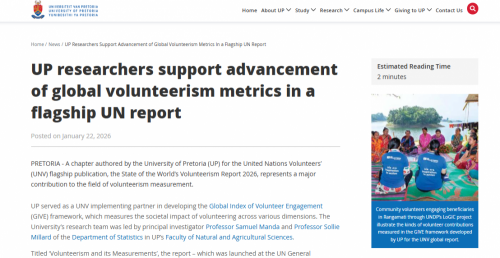
UP served as a UNV implementing partner in developing the Global Index of Volunteer Engagement (GIVE) framework, which measures the societal impact of volunteering across various dimensions. The University’s research team was led by principal investigator Professor Samuel Manda and Professor Sollie Millard of the Department of Statistics in UP’s Faculty of Natural and Agricultural Sciences.
Titled ‘Volunteerism and its Measurements’, the report – which was launched at the UN General Assembly in New York on International Volunteer Day, 5 December 2025 – explores why and how volunteering should be measured, presents updated global estimates of volunteer work, and examines how volunteering contributes to development outcomes, individual well-being, and responses to multiple, overlapping crises.
The comprehensive eight-chapter report makes a compelling case for greater recognition and investment in volunteering, while highlighting persistent global challenges in data availability, measurement and impact assessment. It addresses long-standing evidence gaps that have led to a limited understanding of the impact of volunteering over time.
By strengthening the measurement of volunteerism, the State of the World’s Volunteerism Report advances a more robust evidence base for integrating volunteering into development planning, policy formulation and crisis response. It identified critical gaps in volunteering data and impact measurement; this led to the recommendation to establish GIVE, as developed by UP.
“GIVE moves beyond traditional participation metrics, such as the number of volunteers or hours volunteered, which capture only a partial view of the contribution of volunteers,” Prof Manda explains. “The index is part of a decade-long effort by the UNV to advance the recognition, impact and contribution of volunteering through data-driven policy and interventions.”
The index measures the societal impact of volunteering across four interconnected areas: individual value (personal growth, fulfilment and well-being); community and societal value (social cohesion, trust and resilience); economic value (contributions to local and national economies); and an enabling environment (the conditions, policies and institutions that support volunteering).
Designed to complement established global indices such as the Human Development Index (HDI) and the Multidimensional Poverty Index (MPI), GIVE provides governments and development partners with a universally applicable framework for measuring the vital, yet often unseen, contributions of volunteers in achieving the Sustainable Development Goals.
“The completion of the GIVE framework represents a milestone in trust and institutional capacity,” Prof Manda says. “It reflects the UNV’s confidence in entrusting this ambitious global initiative to a university in the Global South, and demonstrates UP’s ability to deliver world-class, policy-relevant research with international impact.”
With the framework now established, the next phase will focus on operationalising GIVE into a full-fledged global index, much like that of the HDI and MPI, through data collection, computation, validation, dissemination and long-term institutionalisation.
The successful institutionalisation of GIVE requires a collective and sustained effort from policymakers, UN agencies, national statistical offices, researchers, civil society and volunteer organisations, Prof Manda says, adding that through this shared commitment, GIVE can transform how volunteerism is measured, valued and embedded in global development policy.
The report was coordinated by another of UNV’s implementing partners, the Centre for Global Development at Northumbria University in the UK, under the leadership of its co-director Professor Matt Baillie Smith and Dr Bianca Fadel, a research fellow at the centre.
“UP extends its appreciation to Dr Tapiwa Kamuruko, Chief of the Volunteer Advisory Services Section at the UNV, and his team for their excellent support, strategic oversight and outstanding coordination among relevant stakeholders throughout the framing period,” Prof Manda says. “The University also congratulates the entire GIVE research team, including technical contributors and UP support structures, for their dedication and foundational contributions.”