

https://www.sportanddev.org/latest/news/landmark-moment-sport-developmen...
The Youth Charter welcomes the launch of 'The Global Sport and Sustainable Development Goals Baseline and Initial Impact Report' as a landmark and overdue intervention in the global Sport for Development and Peace (SDP) movement. For the first time, the Commonwealth Secretariat, working alongside UNESCO, UN agencies and global partners, has provided a structured, comparable baseline that recognises sport, physical education and physical activity as legitimate contributors to sustainable development across seven interlinked domains.
This report marks an important transition: from advocacy to accountability, from anecdote to evidence, and from aspiration to measurement. It affirms what the Youth Charter and many community-based organisations have argued for more than three decades – that sport is not a peripheral activity, but a social, cultural and economic system capable of contributing meaningfully to health, education, employment, peace, gender equity and institutional integrity. However, a baseline is only the beginning.
From global baseline to community benefit
While the report succeeds in establishing a global measurement framework, the Youth Charter believes the next phase must explicitly anchor baseline indicators to socio-economic outcomes at the community level, particularly within the seven SDG domains identified. Without this translation, there remains a risk that sport’s contribution is recognised statistically but not experienced materially by the communities and young people it purports to serve.
The report itself is candid in acknowledging data gaps, proxy indicators, imputed values and the current inability to attribute direct causal impact. This honesty should be commended. Yet it also underlines a central challenge: measurement without delivery will not unlock investment, and delivery without community-based systems will not produce sustainable impact.
Aligning sport data with socio-economic impact
The Youth Charter, therefore, calls for the next evolution of this work to align the Global Sport and SDG Indicators with:
- Employment creation and skills pathways, particularly for young people as social coaches, educators and community leaders
- Education retention and attainment, linking sport participation to school attendance, progression and lifelong learning
- Health cost avoidance, including reductions in non-communicable diseases, mental health pressures and inactivity-related burdens
- Community safety and cohesion, especially in areas affected by violence, inequality and exclusion
- Gender empowerment outcomes, beyond participation, including leadership, safeguarding and economic independence
Only when sport data is translated into measurable socio-economic return will it meet the investment thresholds required by institutions such as the World Bank, regional development banks and emerging Global Sports Impact Funds.
Thirty years of practice: The community campus model
For over thirty years, the Youth Charter has worked alongside the Commonwealth Secretariat and its member states, not only in policy dialogue but in delivery on the ground. Through this experience, the Youth Charter has developed the Community Campus Model – a place-based, multi-agency framework that integrates sport, culture, education, health and enterprise within disadvantaged communities.
The Community Campus provides precisely the missing link identified in the report: a delivery infrastructure capable of converting indicators into outcomes, and outcomes into evidence that communities genuinely benefit.
By embedding data collection, programme delivery, local governance and social return on investment (SROI) within one ecosystem, the Community Campus offers a scalable mechanism through which the Global Sport and SDG Indicators can be tested, refined and operationalised.
Barriers to implementation: From diagnosis to design
The report identifies significant barriers to implementing its recommendations, particularly:
- Limited resources and infrastructure in small and low-income countries
- Competing national priorities that marginalise sport data
- Bureaucratic inefficiencies and coordination challenges in larger states
- Inconsistent data collection methodologies across regions
The Youth Charter agrees with this diagnosis but argues these barriers will persist unless community-level systems are intentionally designed to overcome them. Centralised data strategies alone will not resolve fragmentation. Instead, locally anchored, globally aligned delivery platforms are required – platforms that allow communities to generate credible data, governments to align policy, and investors to assess risk and return.
From debate to delivery: A global call to action
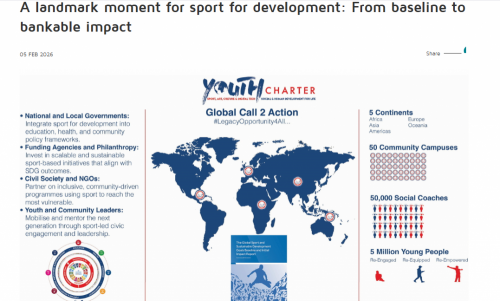
The Youth Charter, therefore, views this report not as an endpoint, but as a call to action. Dialogue, discussion and debate have shaped the SDP field for decades. The time has now come for bankable models, investable frameworks and delivery at scale.
When baseline data is aligned with socio-economic impact, when community campuses translate indicators into lived outcomes, and when global finance institutions recognise sport as a legitimate development asset – then and only then will the Youth Charter’s Global Call to Action be fully realised.
This report has opened the door. The next step is to walk through it – with communities, evidence and investment aligned.