

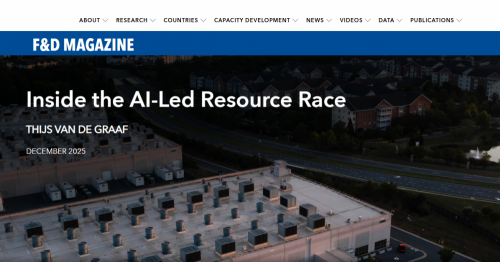
Material demands—for energy, chips, and minerals—will determine who dominates data
Listen with
Speechify
Artificial intelligence is often cast as intangible, a technology that lives in the cloud and thinks in code. The reality is more grounded. Behind every chatbot or image generator lie servers that draw electricity, cooling systems that consume water, chips that rely on fragile supply chains, and minerals dug from the earth.
That physical backbone is rapidly expanding. Data centers are multiplying in number and in size. The largest ones, “hyperscale” centers, have power needs in the tens of megawatts, at the scale of a small city. Amazon, Microsoft, Google, and Meta already run hundreds worldwide, but the next wave is far larger, with projects at gigawatt scale. In Abu Dhabi, OpenAI and its partners are planning a 5-gigawatt campus, matching the output of five nuclear reactors and sprawling across 10 square miles.
Economists debate when, if ever, these vast investments will pay off in productivity gains. Even so, governments are treating AI as the new frontier of industrial policy, with initiatives on a scale once reserved for aerospace or nuclear power. The United Arab Emirates appointed the world’s first minister for artificial intelligence in 2017. France has pledged more than €100 billion in AI spending. And in the two countries at the forefront of AI, the race is increasingly geopolitical: The United States has wielded export controls on advanced chips, while China has responded with curbs on sales of key minerals.
The contest in algorithms is just as much a competition for energy, land, water, semiconductors, and minerals. Supplies of electricity and chips will determine how fast the AI revolution moves and which countries and companies will control it.
A hungry industry
Artificial intelligence is devouring electricity. Data centers already use about 1.5 percent of global electricity supply, roughly the same as the United Kingdom. Only a portion of that demand comes from AI, but it is growing fast. Training an advanced model can consume as much power as thousands of households use in a year, and running it at scale multiplies the burden. The International Energy Agency (IEA) expects data center demand to more than double by 2030, with AI responsible for much of the increase.
Globally this surge is manageable: AI accounts for less than a tenth of added power demand this decade, far below that of electric vehicles or air-conditioning. But national balances tell a different story. In the US and Japan, data centers could account for nearly half of new demand by 2030. In Ireland, they already use more than a fifth of the country’s electricity, the highest share among advanced economies.
The local strains are sharper still. Unlike steel plants or mines, data centers cluster near big cities, can be built in months rather than years, and keep getting bigger. This combination makes them uniquely disruptive to local grids.
In northern Virginia, the world’s largest data hub, data centers already consume about one-quarter of the state’s power, forcing utilities to delay or cancel other connections. Rising electricity bills became a flash point in the state’s governor’s race. In Ireland, Dublin’s grid operator froze new projects in 2022, approving only those that could generate their own power. Singapore halted approvals altogether in 2019 and now allows facilities only under strict efficiency rules.