

https://re-course.org/newsupdates/2026-annual-meetings/
The Recourse team and partners from around the world will be in Bangkok for the 2026 Annual Meetings, 12-18 October, engaging with staff and shareholders at these increasingly influential institutions, and joining the civil society-led activities happening around the official talks.
See below our activities and advocacy asks.
- MEDIA: For interviews and other enquiries, contact Madeleine madeleine[at]re-course.org / +447405351150
Our events and activities
Saturday 10 – Sunday 12 October
Global Gas Convening
Organised by The Big Shift Global coalition
Invitation only
As a member of the Global Gas Working Group, Recourse will present a poster highlighting our work towards the Stop Financing Gas joint campaign.
On Saturday evening, there will be a public event featuring the launch of our Gas is bad economics report and a Global Gas Campaign Toolkit, as well as a panel discussion on Public Finance, Communities, and the Future Beyond Fossil Gas with community and regional perspectives.
Sunday 11 – Monday 12 October
Indigenous Peoples Gathering
Organised by Asia Indigenous Peoples Network on Extractive Industries and Energy (AIPNEE), Forest Peoples Programme, and Recourse
Invitation only
Monday 12 – Tuesday 13 October
International Peoples’ Assembly
Convened by the Asian Peoples’ Movement on Debt and Development (APMDD) and a coalition of organisations including Recourse.
Time: 09:00–18:30
Location: Ambassador Hotel
Click here for details and registration
On Monday 12 October, Recourse is co-convening two thematic sessions:
Climate Justice and Energy Transition
Location: Convention B, 1st Floor, Ambassador Hotel
Time: 11:00–13:00
Debt, Tax, Fiscal Justice and International Finance
Location: Convention B, 1st Floor, Ambassador Hotel
Time: 16:30–18:30
On Tuesday 13 October, Recourse is co-convening one session:
Making use of accountability mechanisms: sharing skills and experience on how MDB complaints can support advocacy strategies
Convention C, 3rd Floor, Ambassador Hotel
Time: 14:45–16:15
Monday 12 – Tuesday 13 October
Feminist Festival of Resistance & Alternatives
Organised by MENAFem Movement and other organisations
Location: Deprime Rangnam Hotel
Click here to register
On Tuesday 13 October, Recourse will moderate a panel:
Reimagining a people’s international development cooperation
Time: 12.00–13:30
Tuesday 13 – Friday 16 October
Civil Society Policy Forum
Part of the official agenda of the Annual Meetings, open for all registered participants in person or virtually. Click here for the full timetable
What is the Value of DPF to Government Policies as Part of the Bank’s Climate Commitments?
Organised by Bank Information Center and others. Sponsored by Recourse.
Speakers include Elle Bartolome, Philippine Movement for Climate Justice.
Date: Tuesday 13 October
Time: 11:00–12:30
Location: 2-211D and online
The World Bank and Just Transition in an Era of Rupture
Organised by Climate Action Network International and others. Sponsored by Recourse.
Date: Tuesday 13 October
Time: 13:00–14:30
Location: 2-211D and online
Better Standards, Better Projects? New Evidence and Real-World Lessons for Successful IFC Investments
Organised by Industrious Labs, Recourse and other organisations.
Speakers include Smith Nwokocha, Quest for Growth and Development Foundation, and Novita Indri, Trend Asia.
Date: Wednesday 14 October
Time: 9:00–10:30
Location: 2-210C and online
Mission 300 at 50 Million Connections: Assessing Implementation and Impact
Organised by Power Shift Africa, Recourse, Bretton Woods Project, Africa Change Lab, Big Shift Global
Speakers include Dean Bhebhe, Director, Africa Change Lab, Rajneesh Bhuee, Recourse, and Karabo Mokgonyana, Power Shift Africa.
Date: Thursday 15 October
Time: 9:00–10:30
Location: 2-211D and online
Rethinking IMF Surveillance and Lending in an Era of Overlapping Shocks
Organised by MENA Fem Movement and others. Sponsored by Recourse.
Date: Thursday 15 October
Time: 11:00–12:30
Location: 2-210A and online
Thursday 15 October
Our Voices Count: A Counter-Docket
Organised by JASS, IAP, ESCR-Net and APWLD, the Counter-Docket creates a space where women and communities most affected by extractive development, debt, and austerity can speak in their own voices and on their own terms.
Time: 09:00–17:00
Location: Sukosol Hotel
Click here for details and registration
Thursday 15 October
Civil society workshops
A financial architecture for just climate finance – how to achieve real Paris alignment of the IFIs?
Time: 10.00–12:30
Combating false finance solutions (FFS) – civil society strategies for debt and climate justice
Time: 12:30–14:00
Location: Holiday Inn Silom, Emerald Room
Co-organised and hosted by Recourse
Invite-only, contact friederike[at]re-course.org in case of interest.
Indigenous Peoples’ Rights and the World Bank Group: Collective Demands for Policy Reforms and Access to Remedy
Organised by AIPNEE, CEMSOJ, Forest Peoples Programme, Tallgrass Institute and Recourse
Location: 2nd Floor, Victor Club at the FYI Center
Time: 14:00–16:00
Open meeting, contact kate[at]re-course.org for more information
Friday 16 October
Civil society strategy session on the IFC/MIGA Sustainability Framework review
Convened by Recourse
Location: Room Victor 2, Victor Club at Sathorn Square
Time: 08:30-10:00
Contact dan[at]re-course.org in case of interest
Global day of action: People rising for justice and liberation!
Coordinated actions taking place in Bangkok, around the world, and online. Click here for details.
Note that this list is subject to change and will be kept updated.
Our advocacy asks for the 2026 Annual Meetings
World Bank Group
The West Asia crisis supply shocks have hit countries in Asia hard, laying bare the risks of relying on imported fossil gas. Yet, the WBG continues to finance mid- and down-stream gas and is considering support for upstream gas projects again.
Our analysis of energy developments in Pakistan, Bangladesh, Nigeria, Namibia and South Africa shows that gas is not clean, cheap or necessary for developing countries – it is simply bad economics, especially when renewable technologies are cheaper than ever.
The Bank should support building renewable economies, rather than externally-driven, profit-oriented investment and fossil dependence. Scaling renewables requires debt-free finance for grids, storage and decentralised technology, alongside national capacity, local manufacturing, decent jobs and meaningful benefits for women, youth and communities.
Additionally, the IDA21 mid-term review, taking place in December this year, must properly assess the climate and development outcomes of the Bank’s finance, while the evaluation of its Climate Change Action Plan (CCAP) should strengthen climate finance accountability.
When it comes to accountability, the WBG is at a crossroads. The closure (without remedy) of recent cases in Cambodia and Nepal have undermined its claims to take accountability seriously. Meanwhile, the merger of its accountability mechanisms has been driven by cost effectiveness and operational efficiency, rather than what works for project-affected people. This risks undermining the WBG’s standing among MDBs, if it results in weaker protections and accountability systems than peers.
There are opportunities to fix this. By strengthening environmental and social (E&S) safeguards in the Sustainability Framework (SF), the IFC and MIGA could regain their place as global E&S leaders. We sent a letter signed by 116 organisations to the Board, urging them to uphold core principles of human rights, no regression, better implementation, and meaningful consultation in the SF review.
Additionally, the CAO investigation into IFC’s financing of the Java 9&10 coal plants in Indonesia is an opportunity to deliver on the promises of its Remedial Action Framework. And there is still time to make the new WBG accountability mechanism truly independent, accessible and effective for complainants.
International Monetary Fund
At the IMF, the Review of Conditionalities risks deepening fiscal adjustment while failing to address how conventional lending can undermine climate and development objectives. More than 130 civil society organisations have called for IMF programmes to move away from austerity, protect social and development spending, address distributional impacts, and ensure alignment with the Paris Agreement and other international commitments.
Our latest research reinforces this concern: across Egypt, Pakistan, DRC, Ecuador and Tanzania, traditional Upper Credit Tranche (UCT) programmes relying on fossil fuels, mining and other extractive exports to generate growth and foreign exchange can constrain the investment needed for a just transition. Climate reforms under the newer Resilience and Sustainability Trust (RST) therefore risk being undermined by a contradictory UCT programme.
The upcoming guidance on programme design and surveillance, action plan in response to the IEO’s climate evaluation, and forthcoming RST review are key opportunities to address this incoherence. We are calling on the Fund to: provide clear guidance to staff for integrating climate-related considerations into UCT programme design; put in place mandatory ex-ante and ex-post distributional, gender and climate impact assessments; and align IMF lending with Paris Agreement goals and, at minimum, do-no-harm.
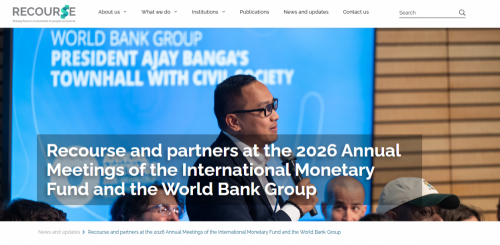
Image: Aaron Pedrosa from the Philippine Movement for Climate Justice asks a question during the World Bank President’s Townhall at the Spring Meetings 2026. Credit: World Bank. License CC-BY-NC-ND-4.0.