

https://www.apc.org/en/pubs/apcs-keynote-address-un-global-dialogue-ai-g...
Thank you Claire. I also wanted to thank the joint organising team of the AI Dialogue and the agencies hard at work this week to provide this space here in Geneva.
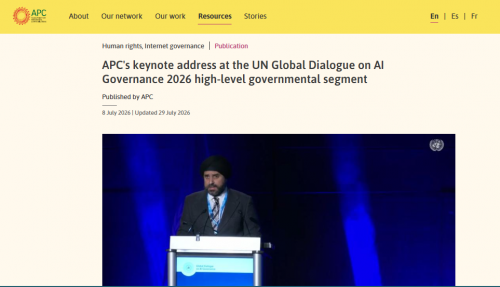
Your excellencies, colleagues: I speak to you on behalf of the Association for Progressive Communications (APC). APC is an international non-profit membership organisation, born in 1990 and whose network now includes 73 organisational members and 44 associates active in over 60 countries. From our beginning, APC’s network and that of our many civil society colleagues have believed it is crucial for the international system to engage with civil society, public interest technologists and grassroots communities on the political and policy aspects of technology development and its governance.
I want to tell you all why I feel a bit uneasy. It would be tempting for us here to focus on conversation on how we should approach the future, and the role that AI and its governance seemingly plays. It is rare to find a truly blank slate. The development of AI and the governance architectures and international institutional process that impact it have their histories that we must learn from.
We must not forget that the development of AI is not inevitable, nor is it a new phenomenon.
The development of the many related technologies that constitute “AI” have had their own history, what some have called “AI springs” and “AI winters”. What may be different about our present AI spring, AI “boom” moment is the extent to which these technologies are not operating in purely academic or technical testing environments, but being deployed across our societies and economies, impacting vulnerable communities and individuals, and occupying the attention of our already strained and contested policy and governance institutions.
The internet has become a mainstream force. That does not mean it is universally accessible or equitable in its development or applications. And this is the problem we need to be honest about in this dialogue. We were still working hard on getting digital governance right, and are now under tremendous pressure to leapfrog into a conversation and design and deploy architecture around AI governance.
Global digital governance processes, including those born from the World Summit on the Information Society, the United Nations Internet Governance Forum and the United Nations Commission on Science and Technology for Development have demonstrated the value of sustained, cross-forum engagement. When we have seen success in global digital cooperation, that has been when governments, civil society, the technical community, academia, the private sector and international organisations have worked together. Many here working with the ITU and UN agencies in Geneva, as well as those working in New York and across the UN system, have recognised that, through much debate and learning alongside civil society and other stakeholders.
AI governance should build on – and not replace – that model. The United Nations system and the different agencies involved in these conversations must remember this as they plan for the next AI Dialogue in New York and design commissions and other forums, especially as the UN undergoes its secretariat leadership changes and other challenges over the coming months.
We need to recognise that the current and upcoming developments around AI raise questions that intersect with existing discussions on connectivity, human rights, standards, development, cybersecurity and digital inclusion.
AI systems are not neutral, given that they are designed and deployed within structures that reflect existing inequalities. Women and girls, gender-diverse people and other marginalised groups are distinctly and disproportionately impacted by the harms of AI systems while being under-represented in the institutions and processes that shape AI development and governance. The Global Dialogue on AI Governance is an opportunity for governments and decision makers to embed commitments based on their existing affirmations on gender equality in digital governance to the AI governance conversation from the start.
While the internet now connects with so much more of our societies and economies, we still see the differentiated and limited access that plagues us. Your gender, your community identity, your geography and more impact whether and what connectivity you are able to access. Absence of connectivity impacts your agency and autonomy – you still have your data scooped up to feed AI models and are often experimented on, but cannot voice your demands, your vision. Connectivity efforts are also impacted by how AI infrastructure conversations around compute infrastructure dominate discussions, rather than the community-centric approaches that we need. These same infrastructure conversations have significant bearing on our climate change crisis, a topic which needs further recognition by the AI Dialogue and increased engagement with impacted communities and environmental defenders. This is why, as my colleague Rebecca Ryakitimbo put it earlier today, we need to reframe the conversations here to talk about communities not as a “last mile” policy problem, but a “first mile” priority and stakeholder.
History has also taught our communities another key learning: do not be afraid of red lines. In particular, we need to be clear on what we deem and enforce as unacceptable with regard to people's rights – including to their data and privacy – and the sustainability of the planet. Last month was the 13-year anniversary of the Snowden revelations. It prompted the UN to recognise and redouble its efforts around the right to privacy in the digital age and so many national reform efforts around surveillance controls. But those all stand at risk of being completely obscured by our current, relentless rush for AI tool usage and partnerships for governments and public sector agencies. We fully agree with the vision alluded to by the Secretary-General and High Commissioner for Human Rights in their remarks this week: we need regulation guided by human rights, a universal recognition around leaving no space for data collection and AI development “without consent”.
Thank you for this opportunity, and civil society looks forward to working on this via the Dialogue and Scientific Panel – through collaboration, challenge and imagination.