

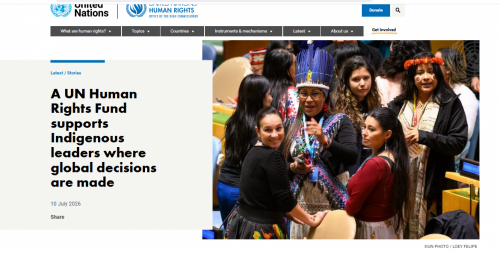
https://www.ohchr.org/en/stories/2026/07/un-human-rights-fund-supports-i...
“From our ancestral lands to the global stage, I realized that every Indigenous voice carries the hopes, wisdom, and aspirations of an entire community,” said Anna Jessa Mae Crisostomo, youth leader of the Obu-Manuvu people and national spokesperson of the Mindanao Indigenous Peoples Youth Organization (MIPYO), Philippines.
“Like many Indigenous youth from developing countries, I have always believed that our communities deserve to be represented in international discussions,” Crisostomo added.
She said that financial barriers often prevent Indigenous Peoples from accessing opportunities and that without the support of the UN Voluntary Fund for Indigenous Peoples (the Fund), participating in the 25th Session of the United Nations Permanent Forum on Indigenous Issues (UNPFII) in New York, last April 2026, would simply not have been possible.
“Being Obu-Manuvu is more than my identity, it is the foundation of who I am,” Crisostomo said. “I was raised to honour our elders as the keepers of our history and wisdom, to value our ancestral domains, and to understand that our culture is not simply inherited but entrusted to us.”
Olga Montúfar Contreras is a Náhuatl Indigenous woman from Mexico, president of the Network of Indigenous and Afro-descendant Women with Disabilities of Latin America and the Caribbean and a 2015 graduate of UN Human Rights’ Indigenous Fellowship Programme. Montúfar Contreras took part in the 19th Conference of States Parties to the Convention on the Rights of Persons with Disabilities from 9 to 11 July 2026 in New York City, also with the support of the Fund.
Olga Montúfar Contreras, a Náhuatl Indigenous woman from Mexico and president of the Network of Indigenous and Afro-descendant Women with Disabilities of Latin America and the Caribbean, at the Conference of States Parties to the Convention on the Rights of Persons with Disabilities in New York. © OHCHR
“This participation matters enormously to me, because very rarely do we Indigenous women with disabilities manage to reach spaces like this,” Montúfar Contreras said. “I feel privileged and that's why you have to come and give your all, because it’s the one chance you get to make yourself heard.”
The UN Voluntary Fund for Indigenous Peoples, managed by UN Human Rights, was established over 40 years ago to support the participation of Indigenous representatives in United Nations meetings and processes where issues affecting them are discussed.
“Increasingly, the Fund also invests in capacity-building, helping grantees of the Fund and Indigenous representatives at large better understand United Nations mechanisms and strengthen the knowledge and skills needed to engage effectively,” said Hernán Vales, head of UN Human Rights’ Indigenous Peoples and Minorities Section.
“For someone like Anna or Olga, this support can make the difference between being able to attend a meeting in person or being absent from discussions that are directly relevant to their communities,” Vales added.
Making the invisible visible
The theme of this year’s Permanent Forum was Indigenous Peoples’ health, including in the context of conflict. Crisostomo used her statement to redefine what that means. For Indigenous Peoples, she said, health is not simply the absence of disease. It is deeply connected to their ancestral lands, culture, identity, spirituality, and their right to self-determination.
“When Indigenous Peoples lose their lands, we do not only lose territory — we risk losing our languages, our traditional knowledge, our cultural heritage, and part of who we are,” Crisostomo added.
For her, that connection is not a metaphor.
“For us, our lands are not simply places where we live. They are our identity, our culture, our spirituality, our traditional knowledge, our livelihoods, and the legacy we leave to future generations,” Crisostomo said.
That is the kind of perspective these spaces miss when Indigenous representatives cannot reach them. UN Human Rights has observed that Indigenous women often bring specific perspectives on land, violence, health, family, community leadership and the transmission of knowledge.
“Indigenous youth bring perspectives on continuity, education, climate change and future generations. Indigenous persons with disabilities bring essential expertise on accessibility, inclusion and the barriers that remain within both national and international systems,” Vales said.
But that visibility was hard-won. Montúfar Contreras remembers the first time Indigenous persons with disabilities appeared at the Permanent Forum, back in May 2012, during the 11th session.
“When we [Indigenous persons with disabilities] first appeared at the Permanent Forum on Indigenous Issues, the Indigenous leaders themselves realized they hadn't accounted for us,” Montúfar Contreras said. “I always remember a Canadian leader who said: I had never imagined a wheelchair in the forest, or a blind person walking along those paths.”
“The Fund was very generous with us. When we began to appear on the scene and saw there was really no participation by Indigenous persons with disabilities, the Fund — at the first opportunity it had to amend its statutes — included us,” she added.
“
The Voluntary Fund selected me for the [Indigenous] Fellowship Programme. And that changed everything.
“
Olga Montúfar Contreras, a Náhuatl Indigenous woman from Mexico, president of the Network of Indigenous and Afro-descendant Women with Disabilities of Latin America and the Caribbean
The Indigenous FellowshipProgramme culminates each year in the session of the Expert Mechanism on the Rights of Indigenous Peoples (EMRIP), and it was there that Montúfar Contreras pressed her case.
“It was the first time I took part in the Expert Mechanism, and I won it over. I got them to hold a half-day of discussion on Indigenous persons with disabilities, and to provide sign-language interpretation,” Montúfar Contreras said. “I was the first Indigenous woman [with disabilities] to participate.”
“
Meaningful participation cannot be limited to those who already have access to resources, networks or visibility. If these spaces are to reflect Indigenous Peoples’ realities, they must include those who face multiple and intersecting barriers.
“
Hernán Vales, head of UN Human Rights’ Indigenous Peoples and Minorities Section
The work begins at home
“Returning home [from New York] was not the end of my journey — it was the beginning of my responsibility,” Crisostomo said. “The Fund is not simply about supporting participation. It is an investment in Indigenous leaders who return home prepared to serve their peoples, strengthen their communities, and inspire the next generation.”
For Crisostomo, that meant turning the Forum’s discussions into action. Back in the Philippines, she carried its recommendations into a round of policy briefings and dialogues with government bodies: from the departments of health and agriculture to the national commissions on Indigenous Peoples and on youth, pressing a single idea.
“Indigenous youth should not only be consulted but should actively participate in developing policies and programs that affect our communities,” Crisostomo said.
Montúfar Contreras explained that with the Fund's support they have submitted alternative reports to the Committee on the Elimination of Discrimination against Women (CEDAW), to the Committee on the Rights of Persons with Disabilities (CRPD), to the Committee on Economic, Social and Cultural Rights (CESCR), and they’ve also taken part in the Universal Periodic Review (UPR).
“We've already brought in many more young people, because in the end we are only transmitters of the knowledge they will have to carry forward — human rights are rights that keep evolving,” Montúfar Contreras said.
The return from the meeting room back to the community, and on to the next generation is what the Fund is built to produce. Grantees are asked from the outset how they will use their participation once the session ends: how they will share what they learn, monitor recommendations, and press their governments to act on them.
“The value of the Fund's support is measured not only by presence in the room, but by what that presence supports afterwards: stronger networks, better-informed advocacy, and more sustained efforts for the recognition and respect of the human rights of Indigenous Peoples,” Vales said.
Montúfar Contreras’s own path, from a Fund grant to the Fellowship and back to the UN mechanisms, is the pipeline Vales describes: the Fund and the Fellowship Programme feeding one another over years, rather than one-off trips. He warns that it’s fragile though.
“When this pipeline contracts, we risk losing continuity, expertise and representation, and the UN system itself becomes less informed by the perspectives of those whose rights are being discussed,” Vales said.
The Fund depends entirely on voluntary contributions, and today it can support fewer than 5 per cent of the applications it receives.
“We would not be where we are now in terms of Indigenous rights without the key support from the Fund,” Vales said.
For Crisostomo, what is at stake is simple.
“Development should never require Indigenous Peoples to leave behind who they are,” she said.
“
You belong. The United Nations is not a distant place reserved for a few — it is also a space where Indigenous Peoples can be heard, respected, and empowered.
“
Anna Jessa Mae Crisostomo, youth leader of the Obu-Manuvu people
About the UN Voluntary Fund for Indigenous Peoples
The UN Voluntary Fund for Indigenous Peoples helps Indigenous representatives take part in the UN meetings and processes where the issues affecting them are decided. Established 40 years ago and administered by the UN Human Rights Office, the Fund provides grants — awarded by a Board of Trustees — that cover the cost of travel, accommodation and participation, and increasingly support training so that recipients can engage with UN mechanisms more effectively. It works alongside the OHCHR Indigenous Fellowship Programme to help build a lasting foundation of Indigenous leadership within the UN human rights system. The Fund depends entirely on voluntary contributions and can currently support fewer than 5 per cent of the applications it receives.