

by Joseph Wilde-Ramsing
https://www.somo.nl/person/joseph-wilde-ramsing-2/
https://www.somo.nl/telenor-failed-to-respect-human-rights-in-myanmar-sale/
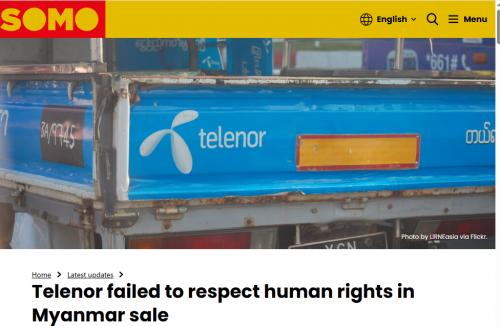
The Norwegian National Contact Point (NCP) for the OECD Guidelines for Multinational Enterprises on Responsible Business Conduct has found that Norwegian telecoms company Telenor breached international standards on human rights and responsible business conduct. The decision confirms the complainants’ claim that Telenor failed to respect human rights and failed to conduct human rights due diligence concerning its operations in Myanmar and its disengagement from Myanmar following the military coup in 2021.
Telenor’s irresponsible disengagement
In July 2021, SOMO filed a complaint on behalf of 474 Myanmar civil society organisations with the Norwegian NCP. The complainants accused Telenor of violating the OECD Guidelines before, during, and after the sale of its subsidiary, Telenor Myanmar.
As Myanmar’s human rights situation rapidly deteriorated following the military coup in February 2021, Telenor announced that it would divest from Myanmar by selling Telenor Myanmar to the Lebanese company M1 Group. The complaint alleged that Telenor failed to conduct adequate due diligence, as M1’s owner had investment ties to the Myanmar military and businesses in other authoritarian countries. This raised fears that Telenor Myanmar would, after the sale, readily comply with military requests for sensitive personal data on its more than 18 million users, which could be used to persecute political dissidents.
Despite the filing of the complaint, Telenor Myanmar was sold in March 2022 to a consortium comprising M1 and Shwe Byain Phyu, a Myanmar conglomerate closely linked to the military.
The complainants and Telenor reached an interim agreement during mediation in 2022. However, mediation ultimately failed as Telenor refused to discuss its contribution to a Myanmar digital resilience mechanism, which would mitigate and prevent human rights risks and impacts associated with Telenor’s sharing of data with the military regime.
NCP condemns Telenor’s conduct
The NCP’s final ruling on the complaint finds that Telenor acted in breach of the OECD Guidelines.
The NCP determined that Telenor did not carry out human rights due diligence commensurate with the severity and likelihood of the adverse impacts with which it was involved in Myanmar. It found that “provision of user data to a military junta that uses the data for surveillance of political opponents may be regarded as contribution to adverse human rights risks and impacts” and that Telenor avoided taking “nearly any possible actions to mitigate the risks for end users”, such as helping customers protect their communication.
Furthermore, the NCP concluded that Telenor was not prepared for the situation created by the military coup in February 2021, as its human rights due diligence and risk assessments had not encompassed the possibility of full military rule and the corresponding responsible exit scenarios. The decision also states that Telenor did not provide customers with any assistance on how they should protect themselves from misuse of authority requests for information.
Lastly, the NCP determined that Telenor should take an active role in remediation and recommends that Telenor provide financial support to a Myanmar digital security relief mechanism.
“Telenor has betrayed its 18 million users and left them at risk from the military junta’s surveillance and repression. It must now follow the NCP’s decision to remediate those who have been harmed by Telenor’s actions.”
Ko Ye, former Telenor Myanmar customer and one of the complainants
“The NCP’s decision affirms the concerns we raised about Telenor’s irresponsible behaviour and exit from Myanmar. It sets an important precedent regarding corporate accountability in high-risk contexts, and it is a powerful acknowledgement that businesses should never disengage irresponsibly. If they do, they are on the hook for remediating the harm.”
Joseph Wilde-Ramsing, Advocacy Director at SOMO
Telenor’s handover of data
In August 2025, the Norwegian Broadcasting Corporation (NRK) revealed that Telenor Myanmar had repeatedly complied with military requests to hand over customer data even before the sale.
A number of Myanmar citizens and non-profit organisations have subsequently notified Telenor of their intention to sue for compensation in relation to the human rights violations arising from Telenor’s sharing of data.
Although the NCP in the present complaint did not investigate specific cases of Telenor’s sharing of user data with the military, it states that it is “probable” that Telenor’s sharing of data could have been a “part of a puzzle” which enabled the military to identify and persecute opponents.
Fight for justice continues
The Standing Committee on Scrutiny and Constitutional Affairs of the Norwegian Parliament is moving towards a formal inquiry into the involvement of the Norwegian government in Telenor’s operations in Myanmar, as the Norwegian state is the majority owner of Telenor. The NCP’s findings could potentially inform the Parliament’s investigation.
While the complainants welcome the final statement as a recognition of Telenor’s responsibility, victims of Telenor’s actions are continuing with their fight for justice through the intended lawsuit concerning the company’s sharing of customer data.
Joseph is SOMO’s Advocacy Director and has a broad experience and expertise in corporate accountability across a wide range of sectors, including energy, extractives, manufacturing and finance.
After leading the OECD Watch network for 15 years between 2005-2020, he now serves as a Senior Advisor to the network. He frequently assists communities and workers in documenting human rights and environmental violations, asserting their rights and seeking remedy for corporate abuse. Joseph serves as an Independent Advisor to the Social and Economic Council (SER) of the Netherlands and is on the Advisory Board of the Dutch National Contact Point for the OECD Guidelines.
Joseph holds Bachelor degrees in Political Science and Spanish from the University of North Carolina at Asheville, and a Master’s degree in political science from Tulane University. In 2013, he received a Ph.D. in political science and governance from the University of Twente in the Netherlands. He joined SOMO in 2005.