

https://www.iwf.org.uk/news-media/blogs/social-media-ban-why-a-big-tech-...
Written by: Kerry Smith, IWF Chief Executive Officer
It’s clear when a Government policy has cut through and touched people’s lives.
The decision to limit under 16s’ access to social media is one of those moments. It is reverberating around the world. It is being discussed over dinner tables, in workplaces, on busses, and in school yards.
When young people, their parents, your colleagues, and the world’s biggest companies all have an opinion on an issue, you know the ripples will be felt well beyond Westminster – potentially for generations to come.
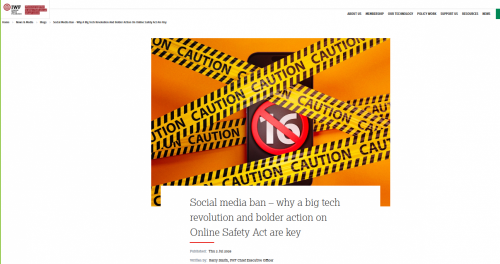
The so-called social media ban is a revolutionary step, but is this a revolutionary moment for child safety?
Because that is what’s needed. At the Internet Watch Foundation, we see the results of some of the most extreme online harms imaginable.
We see children and young people facing sexual exploitation wherever we look. From extremely young children being groomed in minutes, to boys facing financial ‘sextortion’ at the hands of ruthless criminals, to the increasing commercialisation of children’s sexual abuse, with girls often facing the disproportionate brunt of sexual violence.
The Government is right to take decisive and bold action here. And it is about time. But there is no single quick fix. Prohibiting under 16s from social media alone will not stem the tide of abuse we are seeing and will not make the internet a safer place unless further steps are taken.
At worst, the ban could even send the wrong signal that companies can roll back on hard won safety steps they have already taken.
We often hear that this is less about banning children’s access to the internet, and more about banning the internet’s access to children. We believe there are wonderful and constructive opportunities for young people online, and that social media can be part of that. But they need to be able to do that in an environment free from harm.
Young people should be allowed to communicate, share stories, play, and learn with each other, online and offline, in safety. They deserve an internet which has been built with their safety in mind, and which they can use without being preyed upon.
It’s safety by design, and it’s more than a slogan. It’s the way every new tool, platform, service, and product should be created before they are unleashed on the global public.
So, what will really make a big difference? Greater safeguards for end-to-end encrypted environments would make whole swathes of the internet safer, and give criminals fewer places to hide and distribute child sexual abuse.
Companies should be prepared to completely revolutionise their processes where necessary to ensure services are safe by design and to stop unsafe products from reaching the market. This principle should apply regardless of whether children will be banned from the service or not.
The Government should also be looking at strengthening the enforcement of the Online Safety Act to address existing gaps in legislation and match the original ambition of the Act. Fortifying regulatory levers will also be an essential step if the Government wants to deliver a decisive and bold blow for child safety.
Children’s online safety is very real, the threats they face are real – and the impact on a whole generation will be difficult to fully grasp. It may be years before we understand the true scale of the harm we are witnessing now.
Now, the Government has set their sights on protecting our children. We welcome this. Banning them from social media, though, is not the answer on its own. It needs to be part of a wider and tougher range of solutions.
Rather than simply stopping under 16s being on social media sites, we should also be thinking about how those sites can be made into safer places where they can thrive. Whatever levers are pulled to make that happen – this needs to be the end goal. Getting it right is critical.
The Internet Watch Foundation submitted a formal response to the UK Government’s national consultation on children’s online safety, Growing up in the online world.
Our response set out urgent recommendations to tackle child sexual abuse and exploitation (CSEA) online - spanning end-to-end encrypted environments, AI chatbots, and device-level protections.
ABOUT
Working to stop child sexual abuse online
Protecting children is at the heart of everything we do. For over 29 years, since the early days of the internet, our job has been to help child victims of sexual abuse by hunting down and removing any online record of the abuse.
It’s a tough job. Our image analysts are amongst the best in the world. The children in the pictures are real. Their abuse and suffering is very real. Our experts never forget that.
The criminals who sexually abuse children, then record their suffering and share the horror online are ruthless. Sometimes they create images with audiences in mind. Victims range from babies to young teens. Abusers are often experienced at online grooming, skilled at manipulating young minds. Sometimes victims don’t even realise they are being abused until it’s too late.
Sadly, the internet makes it easier to share these images. We use advanced technology and human expertise to help young victims. If we can remove the record of suffering online and stop those images circulating, then we can stop the abuse being perpetuated. This makes the internet a safer place for all children and adults.
The children in the pictures are real. Their abuse and suffering is very real. Our experts never forget that.
How we do this
- Tech-for-good. We build cutting-edge tech tools designed to make it easier to identify and remove online images and videos of child sexual abuse. In short, tech to protect kids.
- Our team of human analysts. Tech companies and law enforcement worldwide trust the assessments, experience and knowledge of our extraordinary team of people.
- Working together. With international partners in government, law enforcement, reporting hotlines, charities and the tech community we work to stop illegal images of children being circulated again and again. We share vital information that could lead to the rescue of a child from terrible abuse.
- IWF Hotline. This gives people a safe and anonymous place to report suspected online images and videos showing the sexual abuse of children. When we started in 1996, 18 per cent of child sexual abuse imagery online was hosted in the UK. Today, thanks to our Hotline, it’s less than one per cent. We’re proud of that.
We are an independent not-for-profit organisation. Tech companies, our ‘Members’, companies and the public fund our work. Our donors are extraordinary people who care about keeping children safe online. They’re our IWF heroes.
Our experience and data is unique. We use this expertise to help governments shape new laws, laws that will benefit victims of child sexual abuse and give the best possible protection to children online. Our Policy Team is supported by IWF Champions, UK Members of Parliament who have signed-up to help spread the word about protecting children online.
We also run public campaigns, to help share our learning. Encouraging teenage boys who might have accidently stumbled on child abuse images to report to our Hotline, or helping parents have difficult conversations with their children about staying safe online are important messages for people.
At IWF we recognise online child sexual abuse imagery is a global problem, which demands a global solution. So, we’ve taken our fight to countries without anywhere to report online child sexual abuse. Working in partnership with local people, we provide scaled down Reporting Portals which feed directly to our expert analysts in the UK. Today we have over 50 of these portals.
It’s all part of our mission to help victims of child sexual abuse worldwide, by identifying and removing the online record of their abuse. If you share our vision, why not consider making a donation, or if you represent a company, take a look at memberships and partnerships.
We use the term child sexual abuse to reflect the gravity of the images and videos we deal with. 'Child pornography', 'child porn' and 'kiddie porn' are not acceptable descriptions. A child cannot consent to their own abuse. Read more.
It’s clear when a Government policy has cut through and touched people’s lives.
The decision to limit under 16s’ access to social media is one of those moments. It is reverberating around the world. It is being discussed over dinner tables, in workplaces, on busses, and in school yards.
When young people, their parents, your colleagues, and the world’s biggest companies all have an opinion on an issue, you know the ripples will be felt well beyond Westminster – potentially for generations to come.
The so-called social media ban is a revolutionary step, but is this a revolutionary moment for child safety?
Because that is what’s needed. At the Internet Watch Foundation, we see the results of some of the most extreIt’s clear when a Government policy has cut through and touched people’s lives.
The decision to limit under 16s’ access to social media is one of those moments. It is reverberating around the world. It is being discussed over dinner tables, in workplaces, on busses, and in school yards.
When young people, their parents, your colleagues, and the world’s biggest companies all have an opinion on an issue, you know the ripples will be felt well beyond Westminster – potentially for generations to come.
The so-called social media ban is a revolutionary step, but is this a revolutionary moment for child safety?
Because that is what’s needed. At the Internet Watch Foundation, we see the results of some of the most extreme online harms imaginable.
We see children and young people facing sexual exploitation wherever we look. From extremely young children being groomed in minutes, to boys facing financial ‘sextortion’ at the hands of ruthless criminals, to the increasing commercialisation of children’s sexual abuse, with girls often facing the disproportionate brunt of sexual violence.
The Government is right to take decisive and bold action here. And it is about time. But there is no single quick fix. Prohibiting under 16s from social media alone will not stem the tide of abuse we are seeing and will not make the internet a safer place unless further steps are taken.
At worst, the ban could even send the wrong signal that companies can roll back on hard won safety steps they have already taken.
We often hear that this is less about banning children’s access to the internet, and more about banning the internet’s access to children. We believe there are wonderful and constructive opportunities for young people online, and that social media can be part of that. But they need to be able to do that in an environment free from harm.
Young people should be allowed to communicate, share stories, play, and learn with each other, online and offline, in safety. They deserve an internet which has been built with their safety in mind, and which they can use without being preyed upon.
It’s safety by design, and it’s more than a slogan. It’s the way every new tool, platform, service, and product should be created before they are unleashed on the global public.
So, what will really make a big difference? Greater safeguards for end-to-end encrypted environments would make whole swathes of the internet safer, and give criminals fewer places to hide and distribute child sexual abuse.
Companies should be prepared to completely revolutionise their processes where necessary to ensure services are safe by design and to stop unsafe products from reaching the market. This principle should apply regardless of whether children will be banned from the service or not.
The Government should also be looking at strengthening the enforcement of the Online Safety Act to address existing gaps in legislation and match the original ambition of the Act. Fortifying regulatory levers will also be an essential step if the Government wants to deliver a decisive and bold blow for child safety.
Children’s online safety is very real, the threats they face are real – and the impact on a whole generation will be difficult to fully grasp. It may be years before we understand the true scale of the harm we are witnessing now.
Now, the Government has set their sights on protecting our children. We welcome this. Banning them from social media, though, is not the answer on its own. It needs to be part of a wider and tougher range of solutions.
Rather than simply stopping under 16s being on social media sites, we should also be thinking about how those sites can be made into safer places where they can thrive. Whatever levers are pulled to make that happen – this needs to be the end goal. Getting it right is critical.
The Internet Watch Foundation submitted a formal response to the UK Government’s national consultation on children’s online safety, Growing up in the online world.
Our response set out urgent recommendations to tackle child sexual abuse and exploitation (CSEA) online - spanning end-to-end encrypted environments, AI chatbots, and device-level protections.
tables, in workplaces, on busses, and in school yards.
When young people, their parents, your colleagues, and the world’s biggest companies all have an opinion on an issue, you know the ripples will be felt well beyond Westminster – potentially for generations to come.
The so-called social media ban is a revolutionary step, but is this a revolutionary moment for child safety?
Because that is what’s needed. At the Internet Watch Foundation, we see the results of some of the most extreme online harms imaginable.
We see children and young people facing sexual exploitation wherever we look. From extremely young children being groomed in minutes, to boys facing financial ‘sextortion’ at the hands of ruthless criminals, to the increasing commercialisation of children’s sexual abuse, with girls often facing the disproportionate brunt of sexual violence.
The Government is right to take decisive and bold action here. And it is about time. But there is no single quick fix. Prohibiting under 16s from social media alone will not stem the tide of abuse we are seeing and will not make the internet a safer place unless further steps are taken.
At worst, the ban could even send the wrong signal that companies can roll back on hard won safety steps they have already taken.
We often hear that this is less about banning children’s access to the internet, and more about banning the internet’s access to children. We believe there are wonderful and constructive opportunities for young people online, and that social media can be part of that. But they need to be able to do that in an environment free from harm.
Young people should be allowed to communicate, share stories, play, and learn with each other, online and offline, in safety. They deserve an internet which has been built with their safety in mind, and which they can use without being preyed upon.
It’s safety by design, and it’s more than a slogan. It’s the way every new tool, platform, service, and product should be created before they are unleashed on the global public.
So, what will really make a big difference? Greater safeguards for end-to-end encrypted environments would make whole swathes of the internet safer, and give criminals fewer places to hide and distribute child sexual abuse.
Companies should be prepared to completely revolutionise their processes where necessary to ensure services are safe by design and to stop unsafe products from reaching the market. This principle should apply regardless of whether children will be banned from the service or not.
The Government should also be looking at strengthening the enforcement of the Online Safety Act to address existing gaps in legislation and match the original ambition of the Act. Fortifying regulatory levers will also be an essential step if the Government wants to deliver a decisive and bold blow for child safety.
Children’s online safety is very real, the threats they face are real – and the impact on a whole generation will be difficult to fully grasp. It may be years before we understand the true scale of the harm we are witnessing now.
Now, the Government has set their sights on protecting our children. We welcome this. Banning them from social media, though, is not the answer on its own. It needs to be part of a wider and tougher range of solutions.
Rather than simply stopping under 16s being on social media sites, we should also be thinking about how those sites can be made into safer places where they can thrive. Whatever levers are pulled to make that happen – this needs to be the end goal. Getting it right is critical.
The Internet Watch Foundation submitted a formal response to the UK Government’s national consultation on children’s online safety, Growing up in the online world.
Our response set out urgent recommendations to tackle child sexual abuse and exploitation (CSEA) online - spanning end-to-end encrypted environments, AI chatbots, and device-level protections.We see children and young people facing sexual exploitation wherever we look. From extremely young children being groomed in minutes, to boys facing financial ‘sextortion’ at the hands of ruthless criminals, to the increasing commercialisation of children’s sexual abuse, with girls often facing the disproportionate brunt of sexual violence.
The Government is right to take decisive and bold action here. And it is about time. But there is no single quick fix. Prohibiting under 16s from social media alone will not stem the tide of abuse we are seeing and will not make the internet a safer place unless further steps are tak