

https://www.bankingonclimatechaos.org/?bank=JPMorgan%20Chase#fulldata-panel
https://www.theguardian.com/environment/2026/jun/09/world-banks-pledge-b...
https://www.ran.org/press-releases/bocc26/
Global banks financed fossil fuels with $8.7 trillion since the Paris Agreement; $906 billion in 2025 alone; JPMorgan Chase, Bank of America, and MUFG are the world’s three worst funders
Banking on Climate Chaos report reveals nearly $1 trillion in annual fossil fuel financing as bank policy rollbacks accelerate and fossil energy instability deepens the global cost-of-living crisis
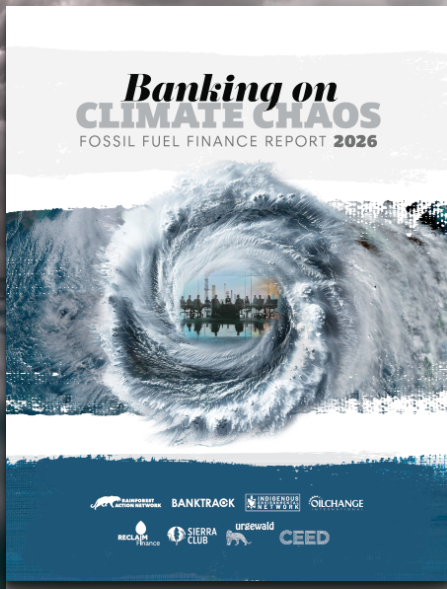
June 8, 2026, New York, NY — Released today, the 17th edition of Banking on Climate Chaos (BOCC) report finds that the world’s 65 largest banks committed $906 billion to fossil fuel companies in 2025, an increase of 8% from the previous year. Since the Paris Agreement was signed a decade ago, these banks have channeled $8.7 trillion into oil, gas, and coal operations. The report is the world’s most comprehensive open-source dataset on fossil fuel financing by commercial banks.
The report finds that JPMorgan Chase remains the #1 fossil fuel financier in the world, providing $58 billion to fossil fuel companies in 2025, up 12.6% from 2024. Bank of America ranks second at $47 billion, and Japan’s Mitsubishi UFJ Financial Group (MUFG) ranks third at $47 billion, a 21% increase in a single year. The “Dirty Dozen” — the twelve largest fossil fuel banks — now provide nearly 40% of all global bank fossil fuel financing across approximately 2,000 banks worldwide.
Financing for companies actively expanding fossil fuels surged 27% to $508 billion in 2025. Any such expansion financing is incompatible with limiting global warming to 1.5°C.

US banks’ share of all global bank fossil fuel financing increased to 32%, up from 28% in 2021, and represents the single largest source of fossil capital in the world. European banks show the clearest downward trend. BNP Paribas reduced fossil deals by 28%; UBS by 36%; La Caixa by 34%. Standard Chartered however increased its fossil fuel financing by 28%, Deutsche Bank by 20% and HSBC by 16%.
The report also highlights the limited impacts of voluntary climate commitments and the need for stronger regulatory measures. Following the collapse of the Net-Zero Banking Alliance (NZBA), banks accelerated their policy rollbacks. Of the 15 North American banks in scope, 12 now have no meaningful fossil fuel commitments. JPMorgan Chase and Goldman Sachs abandoned their coal and Arctic exclusions entirely, converting them into case-by-case due diligence standards.
The Cost-of-Living Connection
The fossil energy crises of the 2020s, which are Russia’s invasion of Ukraine and the 2026 US-Israeli war on Iran, show that fossil fuel dependence is a structural source of global instability. Three-quarters of humanity lives in fossil-importing countries and bears the cost of every supply disruption. Following the Iran conflict and closure of the Strait of Hormuz, wholesale gas prices roughly doubled in the EU while emergency rationing spiraled throughout Southeast Asia. Trends show that profits flow upward: 84% of US oil and gas excess profits from the Ukraine crisis went to the wealthiest 10% of individuals while everyone else paid the price. This pattern looks to be repeating itself in 2026.
Fossil Fuel Sector Trends
Key Findings by Sector
(▲ indicates financing increased from 2024 to 2025; ▼ indicates a decrease)
▲ Midstream and methane gas boom: Compared to 2024, top 65 banks increased their financing to midstream expansion companies by an astounding 84%, or $116 billion last year. The three largest individual recipients of bank financing globally were all midstream oil and gas companies last year. LNG/methane is the fastest-growing segment, yet only 5 of the top 65 banks have LNG export terminal exclusion policies.Venture Global — the single largest fossil fuel borrower in 2025 at $33 billion — exemplifies how LNG companies exploit geopolitical conflict for windfall profits.
▲ Expansion financing trends in the oil and gas sector:
▲ Upstream expansion financing increased from $192 billion to $217 billion.
▲ Midstream expansion financing increased from $139 billion to $255 billion.
▲ Gas Power expansion financing increased from $154 billion to $199 billion.
▲ Coal Mining Expansion: Financing surged 77% in 2025, to now $84 billion.
▲ Coal Power Expansion: Rose 40% in one year and is now at $81 billion.
Banking on Climate Chaos is authored by Rainforest Action Network, BankTrack, the Center for Energy, Ecology, and Development, Indigenous Environmental Network, Oil Change International, Reclaim Finance, Sierra Club, and Urgewald. The full dataset — including fossil fuel finance data, policy scores, and frontline stories — is available at bankingonclimatechaos.org.
BOCC From the Authors
Quotes from Authoring Organizations
A decade after Paris, just twelve banks now drive more than a third of the world’s fossil fuel financing — proof that this is no longer a problem of markets, but of a small set of decision-makers making active choices. They are choosing to lock in an energy system that hands record profits to a few fossil firms while passing the costs onto the three of every four people on Earth who depend on imported fuel. The good news is that what a handful of banks built, governments and people worldwide have the power to change.” – Niko Lusiani, Research Director, Rainforest Action Network (co-author)
The twin fossil energy crises of the 2020s have made one thing clear: fossil fuel dependence is not energy security — it is structural vulnerability. Every dollar that still flows to fossil fuel expansion is a death sentence for the most climate-vulnerable peoples.” – Gerry Arances, Executive Director, Center for Energy, Ecology and Development (co-author)
Banks keep telling us they’re committed to climate. Then they abandon their own policies the moment political pressure mounts. Voluntary pledges have had their chance. We need binding rules — not promises.” – Diogo Silva, Campaign Lead, BankTrack (co-author)
Before and after the Paris Accord, Indigenous Peoples have raised alarms that Mother Earth and Father Sky are trying to tell the world the need to move away from a destructive fossil fuel infrastructure and economy that is killing all humanity, and life on the planet. This 2026 report shows bank financing fossil fuel expansion jumped approximately 24% in a single year since 2024. Fossil fuel expansion is a policy of death that locks in decades of future toxic emissions, and continues to be used as a weapon of destruction and death, and being the leading cause of climate change. Indigenous Peoples whose lands and territories sit atop the world’s hydrocarbon basins continue to experience takings of land, human and ecological health impacts, and human rights abuses. Banks are choosing to ignore the rights of Indigenous Peoples. There are no guarantees for safeguarding those rights. We are demanding a Just Transition requiring banks to immediately end all financing for expansion and for governments to legally mandate the phase out of fossil fuels. Now!” – Tom BK Goldtooth, Executive Director, Indigenous Environmental Network (co-author)
Every dollar of finance for oil and gas helps an industry of war profiteers squeeze out short-term profits, further trapping communities into paying higher fossil fuel energy bills, fueling war and conflict, and burning all our futures.
Voluntary commitments aren’t working. No major oil and gas company is doing anything even close to what is needed to hold global heating to 1.5°C, and voluntary banking sector pledges like the Net Zero Banking Alliance aren’t cutting their pipeline of cash. Instead, banks have injected over staggering $900 billion into fossil fuel financing in 2025 alone. Governments must step in and take urgent action to hold financial institutions and fossil fuel companies accountable for their role in the climate crisis.” – David Tong, Global Industry Campaign Manager, Oil Change International (co-author)
The scale of finance still flowing to fossil fuels — especially fossil fuel expansion — shows how deeply major banks remain tied to a climate-wrecking business model. Yet while US and Japanese banks continue to pour billions into coal, oil and gas in pursuit of short-term profits, regardless of the consequences for the living world, some European banks have started adopting measures to restrict financing for new oil and gas upstream expansion. BNP Paribas and Crédit Agricole — both among the world’s ten largest banks and among those that have gone furthest in adopting restrictions on companies developing new oil and gas fields— have shown that such policies can translate into significant reductions in financing. This shows there is no inevitability here: sustained public pressure can force change. The challenge now is to maintain and amplify that pressure until ending fossil fuel finance becomes the norm.” – Lucie Pinson, Director and Founder, Reclaim Finance (co-author)
Major banks are not passive observers of the climate crisis. They are financing the fossil fuel expansion that is making climate risk worse and pushing those costs onto households, communities, and the broader economy. That should alarm institutional investors and pension funds whose portfolios depend on stable insurance markets, functioning housing markets, reliable infrastructure, and a resilient economy. Investors cannot treat bank climate policies as a side issue — continued financing for fossil fuel expansion is a direct contribution to portfolio-wide risk, and banks should be held accountable for deepening the crisis.” – Jessye Waxman, Campaign Advisor, Sierra Club Sustainable Finance Campaign (co-author)
Our research reveals a widening gap between the banks that take the climate crisis seriously and those who act like it doesn’t exist. Banks play a critical role in the transition towards a sustainable energy and economic system, and each one of them should step up to the plate.” – Philipp Noack, Finance Campaigner, Urgewald (co-author)
Full Report and Data
The complete Banking on Climate Chaos 2026 report, dataset, methodology FAQ, policy scores, and media assets are available at bankingonclimatechaos.org. For press inquiries, contact Shawna Ambrose at shawna@ran.org or +1-628-444-2211.
Stories from the Frontlines